


Information
GEEK PICTURES Producer Mamoru Inagaki Speaks at Public Seminar on the Making of Elpis: Hope or Disaster
Elpis: Hope or Disaster is a television drama that aired in 2022 on the Kansai TV and Fuji TV networks.
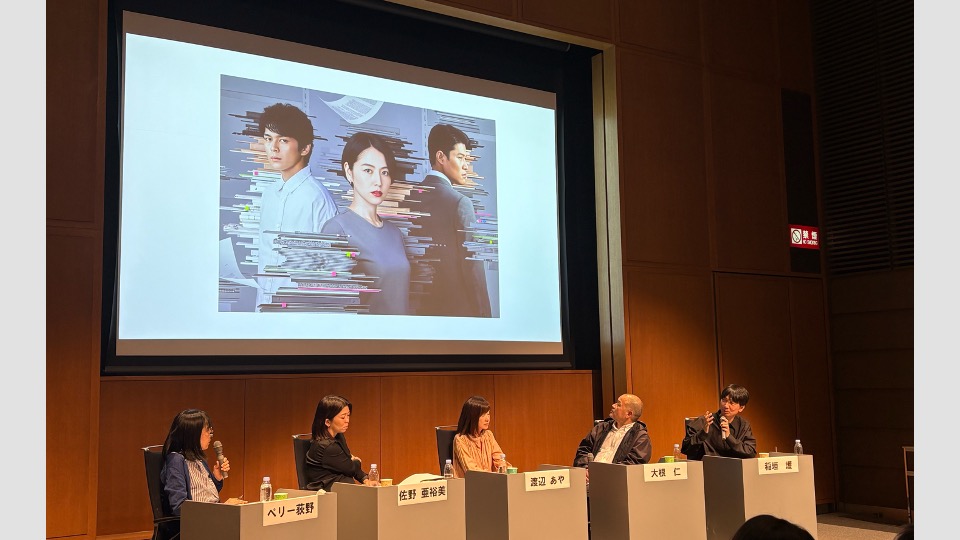
A public seminar offering a behind-the-scenes look at the making of Elpis: Hope or Disaster was recently held as a related event to the exhibition “The History of the Heisei and Reiwa Eras Through Television and Commercials,” organized by the Broadcasting Library.
GEEK PICTURES producer Mamoru Inagaki took the stage alongside Ayumi Sano, who was responsible for planning and producing the series, screenwriter Aya Watanabe, and director Hitoshi One.
The event generated considerable interest even before it was held, receiving more than 1,000 applications for just 200 available seats.
GEEK PICTURES participated in the series as the production company, contributing to a wide range of aspects of the project—from filming and overall production to the creation of the key visual that came to symbolize the series.
During the seminar, the speakers looked back on the journey from the initial concept through to broadcast and discussed the casting process, as well as how GEEK PICTURES became involved in the project. They also shared behind-the-scenes stories about the filming, visual expression, and creation of the key visual.
GEEK PICTURES first became involved in the project when Director One approached Inagaki.
After reading Watanabe’s screenplay, One felt that bringing its world to the screen would require a production structure capable of pursuing the highest level of quality. He turned to Inagaki, with whom he had previously worked on commercials, music videos, and other projects.
Recalling the moment he heard that the project would bring together Sano, Watanabe, lead actress Masami Nagasawa, and Director One, Inagaki said he immediately felt, “This is going to be something extraordinary,” and decided to commit himself fully to the production.
One of the major challenges discussed during the seminar was the decision to shoot the series at 24 frames per second (24p)—an unusual approach for a terrestrial television drama in Japan at the time.
Inagaki explained that cinematographer Toyotaro Shigemori, whose work primarily involves shooting on film, joined the production, and described the project as “one of the most cutting-edge technical challenges undertaken for a commercial television drama.”
The team conducted repeated tests, including examining how the footage would appear when broadcast on terrestrial television, as they pursued a visual style that would best serve the distinctive world of the series.
The seminar also revealed the story behind the creation of the series’ memorable key visual.
Inagaki explained that rather than presenting the serious subject of wrongful conviction in an equally heavy visual style, he wanted to introduce a sense of pop while incorporating a female perspective. This led him to approach art director Yuni Yoshida.
To create the distinctive mosaic-like visual, the team physically collected notebooks in shades of gray, beige, and other colors selected to complement the tones of the characters. Some were specially painted before being stacked to form the set, with the cast positioned between them for the shoot.
When Inagaki revealed that the entire visual had been created practically, using no CGI or compositing whatsoever, the audience responded with audible surprise.
Director One further explained that the key visual went on to inspire the direction of the series’ ending sequence, which incorporated stop-motion animation and grid-like lines. The discussion offered a glimpse into how an idea developed for the key visual ultimately evolved and carried through into the visual language of the series itself.
Covering everything from planning and screenwriting to casting, cinematography, art direction, and visual expression, the seminar provided an in-depth look at the creative process behind Elpis: Hope or Disaster.
Several years after its original broadcast, the event offered an opportunity to revisit how the series came to life—and how the ideas and creative approaches of everyone involved connected with one another and ultimately took shape on screen.
┈┈┈┈┈┈┈┈┈┈┈┈┈┈┈┈┈┈┈┈┈┈
◾️Mamoru Inagaki – Profile
Creative Producer, GEEK PICTURES
Mamoru Inagaki works across a wide range of genres and scales, from advertising films to major large-scale projects.
For the Tokyo 2020 Flag Handover Ceremony at the Closing Ceremony of the Rio 2016 Olympic and Paralympic Games, he was responsible for creative and visual production.
Kenshi Yonezu × PlayStation® “Play Has No Limits” received a Grand Prix at the Clio Entertainment Awards.
In Japan, the TOYOTA “ReBORN” corporate campaign received the ACC Grand Prix, while Suntory “Relay of Song” won both the ADC Grand Prix and the Grand Prix in the Commercial Category at the Galaxy Awards.
The newspaper advertisement for Atarashii Chizu also received the Grand Prize at the 66th Asahi Advertising Awards.
LINKS


